Mouth Taping- Safe or “Sus”?
Mouth breathers get a lot of criticism for snoring, and in trying to find a quick fix, many are turning to a popular trend: Mouth taping.
What is mouth taping?
Mouth taping is the act of taping your mouth shut with medical-grade, skin-safe adhesive tape, forcing nasal breathing to take the place of breathing through the mouth during sleep. It has been recommended by many social media influencers and celebrities who claim it can lead the cessation of snoring, improve sleep, enhance oral health and that it even offers anti-aging results. While the online space markets many products for taping the mouth, and highlights supposed benefits to overall health, many specialists, including Canadian sleep expert Dr. Brain Rotenburg & paediatric sleep medicine specialist Dr Brain Chen, MD, of the world renowned Cleveland Clinic are raising alarm over a trend that can cause more harm than good. Let’s explore.
What mouth taping claims to do:
The theory behind mouth taping is that you will breathe better through your nose, which is the normal and healthy way to breathe. Breathing through the nose, with the tongue resting up against the palate and the lips closed is the biological and physiological way that humans of every age should breathe, and has many health benefits. Nasal breathing:
Releases nitric oxide, opening the blood vessels and helping to maintain optimal blood pressure and circulation
Supports the structure and integrity of the jaws, teeth and face
Keeps the body in a parasympathetic state (rest & digest), supporting the immune system, digestive system and brain, helping us deal with stress and keep a clear mind
Controls air temperature to support lung health
Filters the air and traps unwanted particles from reaching deeper places
Humidifies the air and balances the moisture of the mouth
Improves oxygen levels to the brain and body
Decreases the risk of snoring, dry mouth, bad breath and cavities
Potential risks of mouth taping:
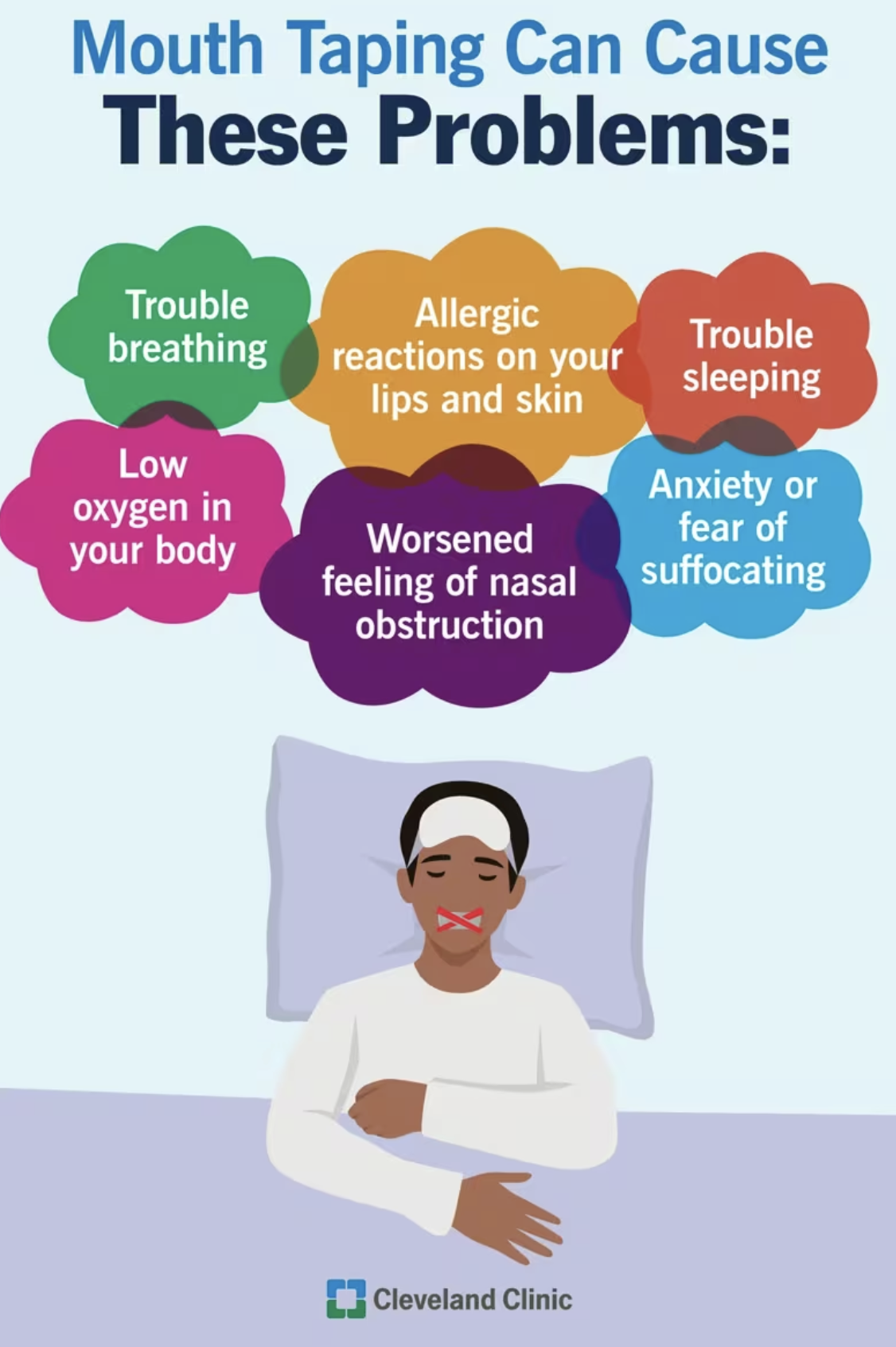
Here’s why it’s dangerous: It’s covering up your symptoms, and not treating the root cause. It’s like using a bandage to cover up a wound without addressing why the wound is there in the first place. Some potential risks of mouth taping include:
Difficulty breathing
Redness, irritation, discomfort or allergic reactions on the lips and skin
Increased anxiety, especially for children and those who have trouble breathing through the nose
Difficulty falling and staying asleep
Restriction of air flow
These potential risks are increased for those with underlying symptoms and conditions such chronic allergies, asthma, lung disease, circulatory issues and sleep apnea. Brian Chen, MD highlights that those with nasal obstruction, nasal congestion, sinus infections, enlarged tonsils, deviated septums, and heart issues should never use mouth tape.
“For individuals already struggling with conditions like nasal obstruction or chronic allergies, mouth taping introduces an unacceptable level of risk,” Dr. Chen emphasizes. “Having your mouth taped closed forces you to rely on only your nose for air, potentially leading to severe respiratory distress, significant drops in oxygen levels and exacerbation of underlying health issues during sleep.”
What does the evidence say?
Although many people swear by mouth taping, it doesn’t treat the root cause of mouth breathing, low tongue posture or snoring, and can put individuals at higher risk of health issues, especially if they have underlying symptoms and conditions.
Dr. Brian Rotenberg, researcher at Lawson, LHSCRI and Schulich Medicine & Dentistry collaborated with Dr. Elise Graham, paediatric otolaryngologist head and neck surgeon at IWK Health along with Jess Rhee, a Schulich School of Medicine & Dentistry resident who is training at London Health Sciences Centre (LHSC) on the research, “examining what science is telling us about this trend and whether or not it is safe.”
He and his team examined 86 existing scientific studies on the topic, including an in-depth review of 10 studies representing the experience of 213 patients. The team found mouth taping:
Has no strong scientific evidence of health benefits, contradicting claims on social media.
Can make existing sleep-disordered breathing worse by restricting airflow, putting additional stress on the respiratory system and increasing risk of suffocation when patients experience a nasal obstruction.
“Our research shows that taping the mouth shut during sleep is dangerous, especially among those who may not be aware they have sleep apnea,” adds Rotenberg, who is also an otolaryngologist and sleep surgeon at St. Joseph’s Health Care London and London Health Sciences Centre (LHSC). “These individuals are unknowingly making their symptoms worse and putting themselves at greater risk for serious health complications like heart disease.”
Rotenberg and his team point to the importance of health research in combatting misinformation and pseudoscience.
“It’s easy for misinformation to run rampant on social media; we’ve seen this countless times over the past years,” says Rhee.
We need to make health decisions based on truths, not trends, and use discernment in the media we are consuming, and the quick fixes they sell.
What’s the alternative?
Understanding the reason why issues such as mouth breathing and snoring arise is an important step in treating the root cause, naturally restoring easeful, healthy nasal breathing day and night.
There are three main reasons why mouth breathing occurs:
There is sinus infection and post nasal drip
It’s a neurological issue where the brain sends out the incorrect signals forcing you to breathe through your mouth, instead of nose
Being overweight: when you lie down, excess pressure on the mouth, throat, chest and lungs can impact the ease of breathing
This happens because of:
Viruses and bacteria (especially streptoccocus & EBV) burrowing in the nasal passages, creating inflammation, infection and chronic congestion, making you unable to breathe through the nose, or restricting airflow
Neurotransmitter signals and electrical impulses being weakend by toxic heavy metals and neurotoxins that are produced by pathogens, such as Epstein Barr Virus.
There are two types of snoring:
Obstructive snoring: obstructive snoring happens when the airway is blocked due to inflammation caused by pathogens, making it difficult to breathe through the obstructed nose, resulting in mouth breathing, and a low tongue posture in the mouth
Neurological snoring: neurological snoring occurs when the cranial nerves, especially the vagus and phrenic nerves are impaired and weakened by toxic heavy metals and neurotoxins that are produced by pathogens
Usually, a combination of these factors is present.
What can I do?
Lower the viral and pathogenic load of the body. You can do this by consuming foods like lemon water, celery juice, wild blueberries, asparagus, ginger, turmeric, garlic, onions, potatoes, bananas, spinach, raw honey, oregano and thyme daily. You can read more about foods that help heal strep bacteria and fight the Epstein-Barr virus here.
In order for healing foods to do their work in reducing the viral load, you’ll also want to stay away from trouble maker foods that actively feed viruses & pathogens in the body, thereby increasing the pathogenic load. Favourite foods of pathogens include eggs, dairy, gluten, soy, corn, and pork, along with processed sugars and fast foods.
Support the immune system and neurological system with critical baseline supplements such as vitamin B-12 with adenosylcobalamin and methylcobalamin, liquid zinc sulphate, lemon balm and cats claw, along with a high-quality, buffered vitamin C powder.
Work with a practitioner: Together we will review your medical and dental histories and evaluate the airway, breathing, swallowing and orofacial complex. An individualized treatment plan will be created to get to the root cause of your issues, and guide you on your journey back to health, meeting you where you are, and building up your toolbox of preventative and healing tools for now and the road ahead.
In sustained health,
